

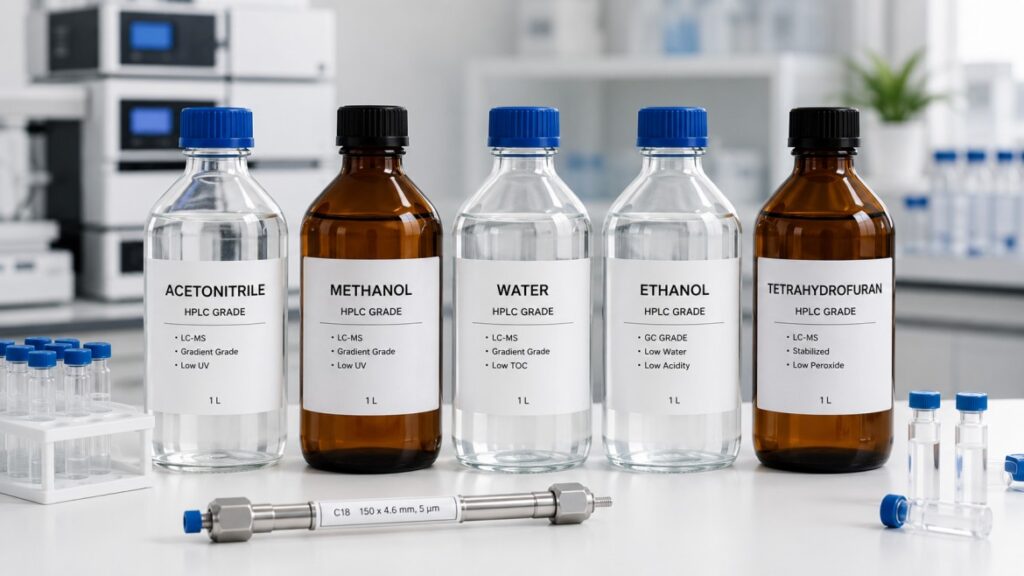
Introduction
Choosing the correct solvent is one of the most important decisions in chromatographic method development. Solvent purity, polarity, viscosity, UV absorbance, volatility, and detector compatibility can influence separation quality, retention behaviour, baseline stability, and instrument cleanliness.
The Solvents for chromatographic applications category includes specialised options for HPLC, GC, LC-MS, and sensitive analytical workflows. Selecting the right grade and composition helps laboratories produce cleaner chromatograms, improve reproducibility, and reduce troubleshooting.
Why Does Solvent Selection Matter?
In chromatography, the mobile phase carries sample components through or across a stationary phase. The relationship between the analyte, solvent, and stationary phase determines how quickly each compound moves and how clearly the mixture separates.
An unsuitable solvent can cause:
- Poor peak resolution
- Unstable baselines
- Unexpected retention changes
- Excessive system pressure
- Low detector response
- Contamination or ghost peaks
- Reduced column life
- Inconsistent results
A solvent should therefore be selected for the analytical technique rather than simply because it dissolves the sample.
Start with the Chromatographic Technique
Different methods place different demands on solvent purity and physical properties. Before comparing individual solvents, laboratories should identify the separation mode, detector, column chemistry, and sample type.
Solvents for HPLC
High-performance liquid chromatography commonly uses water mixed with an organic modifier such as acetonitrile or methanol. The preferred mobile phase depends on analyte polarity, stationary-phase chemistry, selectivity requirements, pressure limits, and detection method.
Laboratories using Solvents for HPLC should look for high purity, low particulate content, consistent composition, and low UV absorbance where optical detection is used. These characteristics help minimise background interference and support stable gradient performance.
Within Liquid chromatography (LC, HPLC), solvent choice must also match the column. Reversed-phase methods usually use aqueous-organic mobile phases, while normal-phase methods rely more on non-polar solvents with stronger polar modifiers.
Solvents for GC
Gas chromatography requires volatile solvents that evaporate efficiently and leave minimal non-volatile residue. The solvent should dissolve the analytes, work with the detector, and avoid interfering with early-eluting compounds.
Suitable Solvents for GC may include purified grades of hexane, methanol, acetone, acetonitrile, or ethyl acetate, depending on the method. Boiling point, stability, sample solubility, and detector compatibility should all be considered.
Solvents for LC-MS
Mass spectrometry is particularly sensitive to solvent impurities, non-volatile salts, metal traces, plasticisers, and background ions. These contaminants may suppress ionisation, increase noise, form unwanted adducts, or obscure low-level analytes.
For this reason, Solvents for LC-MS should be selected specifically for mass-spectrometric workflows. LC-MS-grade water, acetonitrile, methanol, and compatible additives help support cleaner spectra and reliable detection.
Evaluate the Main Solvent Properties
Polarity and Elution Strength
Polarity affects how strongly analytes interact with the mobile and stationary phases. In reversed-phase HPLC, increasing the organic-solvent proportion generally increases elution strength for many retained compounds. Normal-phase chromatography behaves differently because the stationary phase is polar.
Method development often begins with a miscible solvent pair that provides a useful range of elution strength. Small changes in organic content can significantly alter retention and selectivity.
Purity and Residue Levels
General laboratory-grade solvents may contain impurities that are acceptable for routine synthesis but unsuitable for sensitive chromatography. Chromatographic-grade solvents are tested to control residues, trace contaminants, water content, acidity, alkalinity, and detector-relevant impurities.
Higher-purity grades are especially important for gradient HPLC and LC-MS because contaminants can collect at the column head and later appear as ghost peaks or increased background.
UV Cut-Off
With UV or diode-array detection, the solvent must transmit light effectively at the selected wavelength. Excessive absorbance can create a noisy or drifting baseline.
Acetonitrile is often chosen for low-wavelength UV methods because of its favourable optical properties, while methanol can provide different selectivity. The correct choice depends on the analyte and method conditions.
Viscosity and System Pressure
Mobile-phase viscosity influences backpressure in liquid chromatography. Viscous mixtures may increase pressure, especially with small-particle columns or high flow rates.
Temperature, solvent ratio, column dimensions, and instrument limits should be considered together. A system that exceeds pressure limits will not be practical for routine use.
Match the Solvent to Sample Preparation
The sample solvent should be compatible with the initial mobile phase. Injecting a sample in a much stronger solvent can distort peak shape, cause fronting, or reduce resolution.
When cleanup is needed, SPE (Solid Phase Extraction) can remove matrix components and concentrate analytes before analysis. Conditioning, washing, and elution solvents should match the analyte polarity, sample matrix, and sorbent chemistry.
Consider Isocratic and Gradient Methods
In an isocratic method, solvent composition remains constant throughout the run. This approach is suitable when analytes have similar retention characteristics.
Gradient methods change solvent composition over time and help separate complex mixtures with a wide polarity range. These applications require clean solvents because trace impurities may produce baseline disturbances.
Practical Checks Before Final Selection
Before approving a solvent system, laboratories should confirm:
- Complete sample and buffer solubility
- Compatibility between mobile-phase components
- Suitable detector background
- Acceptable system pressure
- Stable retention times and peak areas
- Clear separation of critical analytes
- Low carryover and contamination
- Safe handling and waste disposal
- Consistent performance across batches
The broader field of Chromatography includes many techniques, so no single solvent or grade is ideal for every separation. Method requirements should guide the final choice.
Conclusion
Choosing the right solvent for chromatographic applications requires more than comparing polarity or price. Laboratories must consider the technique, stationary phase, analyte chemistry, detector, purity grade, viscosity, UV cut-off, volatility, and sample-preparation conditions.
HPLC methods need clean and consistent mobile phases, GC methods require volatile and low-residue solvents, and LC-MS workflows demand exceptionally low background contamination. By testing the solvent under real method conditions, laboratories can achieve sharper separations, cleaner baselines, better sensitivity, and more reproducible results.