

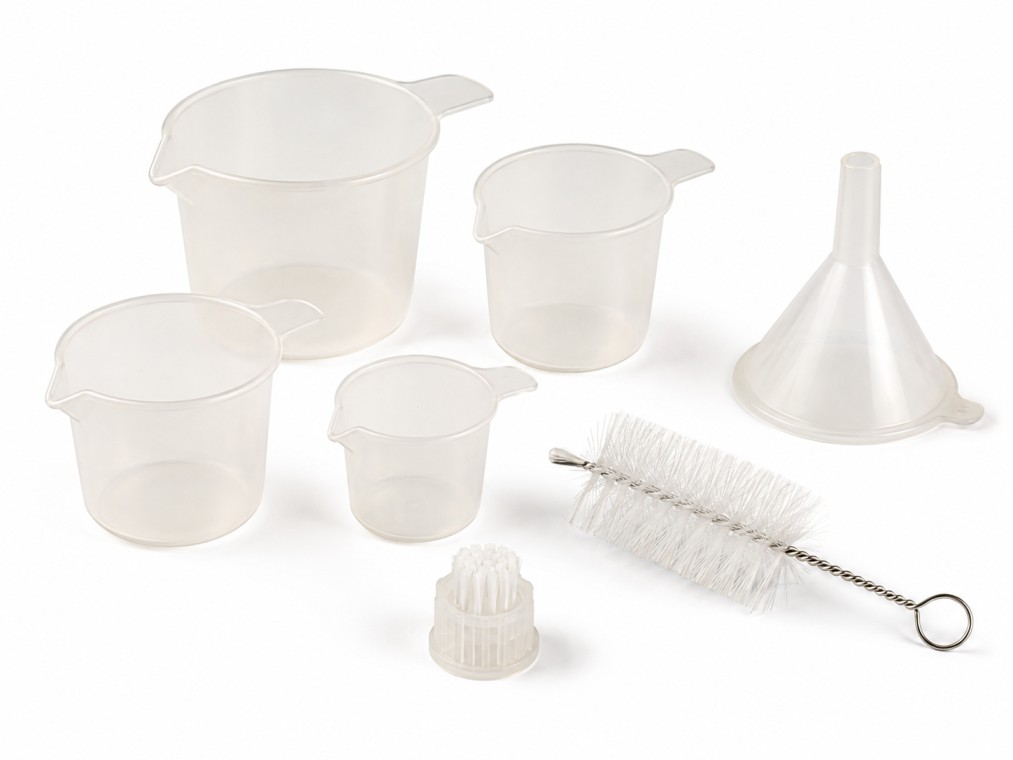
A Practical Guide to Measuring Cups, Funnels, Brushes and Supporting Laboratory Accessories
Efficient laboratory work often depends on small tools that make routine measuring, transferring and handling tasks easier. The Accessories Miscellaneous category brings together practical items such as measuring cups, funnels and brush closures for everyday laboratory, formulation, production and sample-handling applications. Choosing the right accessory can improve workflow consistency, reduce unnecessary material loss and help users handle liquids or other materials more effectively.
What Are Miscellaneous Laboratory Accessories?
Miscellaneous laboratory accessories are supporting tools used to complete routine tasks that may not require complex instruments. They can assist with measuring approximate liquid volumes, transferring liquids or powders between containers, dispensing materials and handling specialised bottles.
These products complement the broader range of Accessories used throughout laboratories, research facilities, manufacturing environments and educational settings. Although individual accessories may appear simple, selecting an appropriate size, material and design can make repeated procedures easier and more organised.
Why Are Small Laboratory Tools Important?
Small accessories often sit between major stages of a workflow. A liquid may need to be measured before formulation, transferred into another vessel before processing or dispensed into a container after preparation.
Using a suitable accessory reduces the need to improvise with equipment that was not designed for the task. This can improve handling control and help maintain cleaner working areas. It may also make repetitive procedures more efficient, particularly where several samples or batches need to be prepared during the same working session.
How Do Measuring Cups Support Routine Liquid Handling?
Laboratory measuring cups provide a convenient way to hold, portion and transfer liquids. Depending on their design, they may be useful for preliminary volume measurement, solution preparation, formulation work or transferring materials between containers.
Material compatibility should always be considered when selecting a measuring cup. Polypropylene and high-density polyethylene are commonly used for laboratory and industrial containers because they offer practical handling properties for many routine applications. The required volume should also be considered so that the vessel provides enough capacity without making smaller quantities unnecessarily difficult to handle.
Measuring cups are particularly useful where rapid preparation and convenient pouring are more important than the high measurement accuracy expected from dedicated volumetric glassware.
Why Are Funnels Useful for Material Transfer?
Funnels create a controlled pathway between a source vessel and a receiving container. They can help minimise spills when transferring liquids and may also support the movement of powders or granular substances into containers with narrow openings.
Choosing the correct funnel requires attention to opening diameter, stem dimensions, construction material and compatibility with the substance being transferred. A funnel that is too small can slow material movement, while an oversized design may be inconvenient for narrow bottles or compact work areas.
For workflows involving dedicated storage systems, users may also require Accessories Canister to support the handling, opening or organisation of compatible canisters. Matching transfer tools with the receiving container can create a more practical end-to-end handling process.
What Role Do Brushes and Brush Closures Play?
Brush-based closures provide a way to combine container sealing with controlled product application. A brush attached to or integrated with a closure can make it easier to apply small quantities directly from a compatible bottle.
This type of accessory can be useful in laboratories, formulation environments and other settings where targeted application is required. The brush dimensions, closure thread and bottle compatibility should be checked carefully because a closure must fit correctly to provide reliable use.
Packaging and formulation workflows may also involve Accessories Cosmetic Products when jars and related containers need appropriate inserts or closure components. Selecting compatible accessories throughout the packaging system can help maintain an organised preparation and filling process.
How Do Container Accessories Support Better Organisation?
Storage containers are only one part of an effective material-handling system. Lids, inserts, keys, funnels and other complementary components determine how easily a container can be filled, opened, accessed and used during routine work.
For materials stored in cans or screw-top containers, Accessories Cans can provide additional components that support appropriate closure and container use. This is particularly relevant where powders, ingredients, laboratory materials or formulation products need to remain organised during storage and handling.
A well-planned system considers the complete workflow rather than selecting each item independently. Container size, closure type, transfer method and material compatibility should work together.
How Should Laboratory Accessories Be Selected?
The best laboratory accessory is one that matches the material, container and intended procedure. Users should first identify what the tool needs to accomplish. For example, transferring a liquid into a narrow bottle requires different equipment from supporting glassware during a laboratory experiment.
Material selection is equally important. Chemicals and solvents can interact differently with plastics, metals and other materials, so chemical compatibility should be checked before use. Capacity, dimensions, temperature conditions and cleaning requirements should also be considered.
Where experiments require equipment to remain securely positioned, supporting components such as Clamps And Rings can complement smaller handling tools by helping stabilise laboratory apparatus during procedures such as heating, titration or general experimental assembly.
Consider the Complete Laboratory Setup
Individual accessories perform best when they are selected as part of the overall laboratory setup. A measuring cup may support preparation, a funnel may assist transfer, a suitable container may provide storage and additional support components may keep experimental equipment positioned correctly.
Laboratory assemblies using stands and rods may also rely on Bossheads to connect supporting components and create adjustable equipment configurations. Integrating suitable handling and support accessories can reduce interruptions caused by missing or incompatible components.
Where Are Miscellaneous Accessories Commonly Used?
These accessories can support many environments because measuring, transferring and dispensing are fundamental activities across scientific and industrial workflows. Research laboratories may use them during sample preparation, while quality-control teams may require them when preparing test materials.
Formulation laboratories can use measuring and dispensing accessories when developing chemical, pharmaceutical, cosmetic or other formulations. Educational laboratories may also require straightforward tools that allow students to perform routine handling procedures efficiently.
Manufacturing and technical facilities can benefit from the same basic principles. Wherever liquids, powders or small quantities of materials must be moved between containers, an appropriately selected accessory can make the process simpler and more controlled.
Building a More Efficient Everyday Laboratory Workflow
Laboratory efficiency is not determined only by advanced instruments. Routine accessories also influence how easily materials move through preparation, transfer, storage and application stages.
Measuring cups help with convenient liquid handling, funnels support controlled transfer and brush closures enable targeted application from suitable bottles. Container and support accessories can further improve organisation by ensuring different parts of the workflow function together.
Selecting accessories according to material compatibility, capacity, container design and intended application helps laboratories create more organised and repeatable working processes. With the right combination of everyday laboratory tools, even simple handling tasks can become easier, cleaner and more efficient.