

How Does a Precision Shunt Simplify High-Current Measurement?
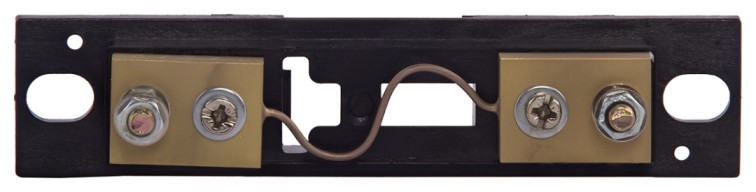
A Sifam Tinsley Brass-Ended Shunt provides a practical way to measure substantial direct current without routing the complete load current through a sensitive measuring instrument. The shunt carries the main circuit current and develops a small proportional voltage that can be measured by compatible instrumentation.
Sifam Tinsley describes its KAPPA series as DIN-standard shunts designed to measure DC current and provide a proportional millivolt output signal. This operating principle makes them useful in battery installations, control panels, DC distribution, industrial power equipment and electrical test systems.
Why Is a 75 mV Shunt Commonly Used for DC Current Monitoring?
A 75 mV shunt is calibrated so its rated current produces a nominal 75 millivolt signal across the sensing points. The connected instrument then scales that small voltage to display the corresponding current value.
For example, EnrgTech lists Sifam Tinsley KAPPA brass-ended versions rated at 10 A, 25 A, 40 A and 100 A with 75 mV outputs. This means the required shunt should be selected according to the actual full-scale current of the application rather than simply choosing any 75 mV model.
Engineers monitoring several electrical quantities can also compare Voltmeters for measuring electrical potential alongside current-monitoring equipment. EnrgTech’s voltmeter range includes both analogue and digital options for DC and AC applications.
How Does a Shunt Convert Current Into a Voltage Signal?
Every conductor has electrical resistance. A precision current shunt uses a deliberately low and controlled resistance so that current flowing through it creates a predictable voltage drop.
Because the resistance is very small, the voltage generated remains in the millivolt range while substantial current can pass through the main terminals.
This proportional relationship allows the measurement device to interpret the voltage as a current reading without placing the full circuit current through the meter’s sensitive measuring mechanism.
What Is the Advantage of Brass-Ended Construction?
Brass-ended shunts provide substantial terminal sections for connecting the high-current conductors while the calibrated resistance section between them produces the measurement signal.
EnrgTech identifies Sifam Tinsley KAPPA products such as YN01-07751BS000000 as brass-ended shunts intended for use with an ammeter. That particular version is rated at 25 A with a 75 mV output.
Secure terminal installation matters because additional resistance at a loose or contaminated connection can create unwanted heating and affect the overall electrical installation.
Where Are Brass-Ended DC Shunts Commonly Installed?
Sifam Tinsley Brass-Ended Shunts are relevant wherever operators need to monitor DC current through a defined circuit.
Typical applications include:
- Battery charging systems
- DC distribution boards
- Industrial control panels
- Telecommunications power systems
- Laboratory DC supplies
- Renewable-energy equipment
- Motor control circuits
- Generator control systems
- Electrical test benches
- Backup power installations
For wider electrical analysis, Power Meters can measure parameters such as voltage, current and power in compatible systems. EnrgTech lists power meters for industrial energy management, electrical monitoring and test applications.
How Is a DC Shunt Different From a Current Transformer?
A shunt and a current transformer can both support current measurement, but they work differently.
A resistive shunt creates a small voltage drop directly from the current flowing through it and is particularly suitable for DC measurement. A conventional current transformer operates through magnetic induction and is primarily associated with alternating-current measurement.
The Current Transformers category includes devices that reduce high AC current to a lower secondary current that compatible meters and protection equipment can process.
Therefore, engineers should select the measurement principle according to whether the circuit is DC or AC, the required isolation, current range and instrumentation architecture.
Can You Measure DC Current Without Installing a Permanent Shunt?
Yes. For maintenance and troubleshooting, technicians may use suitable test instruments rather than permanently installing a panel shunt.
Selected Clamp Meters can measure current by clamping around a conductor, with models available for AC, DC or AC/DC measurements. This approach is particularly convenient where a temporary measurement is required without breaking the conductor path.
A permanent shunt is more appropriate when continuous current indication or integration with fixed instrumentation is required.
What Should You Check Before Selecting a Sifam Tinsley Shunt?
The current rating is one of the first specifications to verify, but it is not the only one.
Buyers should consider:
- Maximum continuous DC current
- Required millivolt output
- Compatible measuring instrument
- Exact Sifam Tinsley part number
- KAPPA series configuration
- Terminal construction
- Mounting arrangement
- Accuracy requirements
- Environmental temperature
- Expected overload conditions
- Available panel space
Sifam Tinsley states that KAPPA shunts extend the measuring ranges of moving-coil DC ammeters and are associated with accuracy class 0.5 instrumentation. The manufacturer also notes that specified lower-current ranges can be supplied on an isolating base adapted for 35 mm DIN-rail assembly.
Can a Multimeter Be Used to Test a Shunt Circuit?
A suitable multimeter can help technicians check circuit voltage and perform troubleshooting around a shunt installation, provided the instrument and measurement procedure are appropriate for the electrical system.
The Multimeters range includes instruments capable of measuring combinations of voltage, current, resistance and other electrical parameters.
When checking a shunt’s millivolt signal, technicians must use an instrument with sufficient resolution and an appropriate input range. Safe measurement practices and the equipment’s voltage category must also match the installation.
Does Shunt Temperature Affect Current Measurement?
Temperature matters because electrical resistance changes with operating conditions. A high-current shunt also dissipates power while carrying load current.
Proper installation therefore requires adequate airflow and correctly tightened current connections. Unexpected heating can indicate overloading, poor connections or an unsuitable installation.
The shunt should always operate within the limits specified for its exact model rather than assuming that all KAPPA variants have identical thermal or overload characteristics.
How Can a Shunt Fit Into a Complete Power Monitoring System?
A shunt may provide only the current-related measurement signal, while a modern monitoring system can track several electrical parameters at once.
Suitable Energy Meters can monitor electrical energy consumption and, depending on the model, parameters such as voltage, current, power and frequency. EnrgTech lists panel-mounted and DIN-rail energy meters for industrial, commercial and energy-management applications.
In more advanced systems, a shunt signal may form one part of a broader monitoring architecture containing meters, controllers and data-acquisition equipment.
Why Is Correct Polarity Important With a DC Shunt?
Direct-current measurement has a defined current direction. Reversing the sensing connections can cause a compatible instrument to indicate reverse polarity, negative current or an incorrect pointer direction depending on the meter design.
The main high-current connections and smaller sensing terminals should therefore be wired according to the shunt and meter documentation.
Technicians should never move or loosen high-current connections while the circuit remains energised.
Can Digital Panel Instrumentation Work With Shunt Signals?
Yes, provided the instrument accepts the shunt’s millivolt signal and can be configured for the required current range.
Modern Digital Panel Multi-Function Meters can measure and display several electrical parameters depending on their available inputs and configuration. EnrgTech’s category includes Sifam Tinsley and other industrial measurement products designed for panel integration.
Compatibility must always be checked between the meter input, shunt output and desired full-scale reading.
What Makes the Sifam Tinsley KAPPA Range Useful?
The KAPPA series provides a straightforward method for extending DC current measurement using a proportional millivolt output. Sifam Tinsley also offers mounting and finishing options across the family, including isolating bases for specified ratings and optional protective coatings such as lacquering, silver plating or nickel plating.
This flexibility allows engineers to select an arrangement appropriate to the electrical rating, panel layout and operating environment.
Why Choose the Correct Sifam Tinsley Brass-Ended Shunt?
A properly selected Sifam Tinsley Brass-Ended Shunt can provide a dependable interface between a high-current DC circuit and lower-level measuring instrumentation.
The key is matching the current rating, millivolt output, meter input, mounting arrangement and operating conditions. When these parameters are correctly coordinated, the shunt can support clear current monitoring across industrial panels, battery systems, power equipment and DC test installations.