

Understanding Removable-Head Barrels for Filling, Storage and Transport
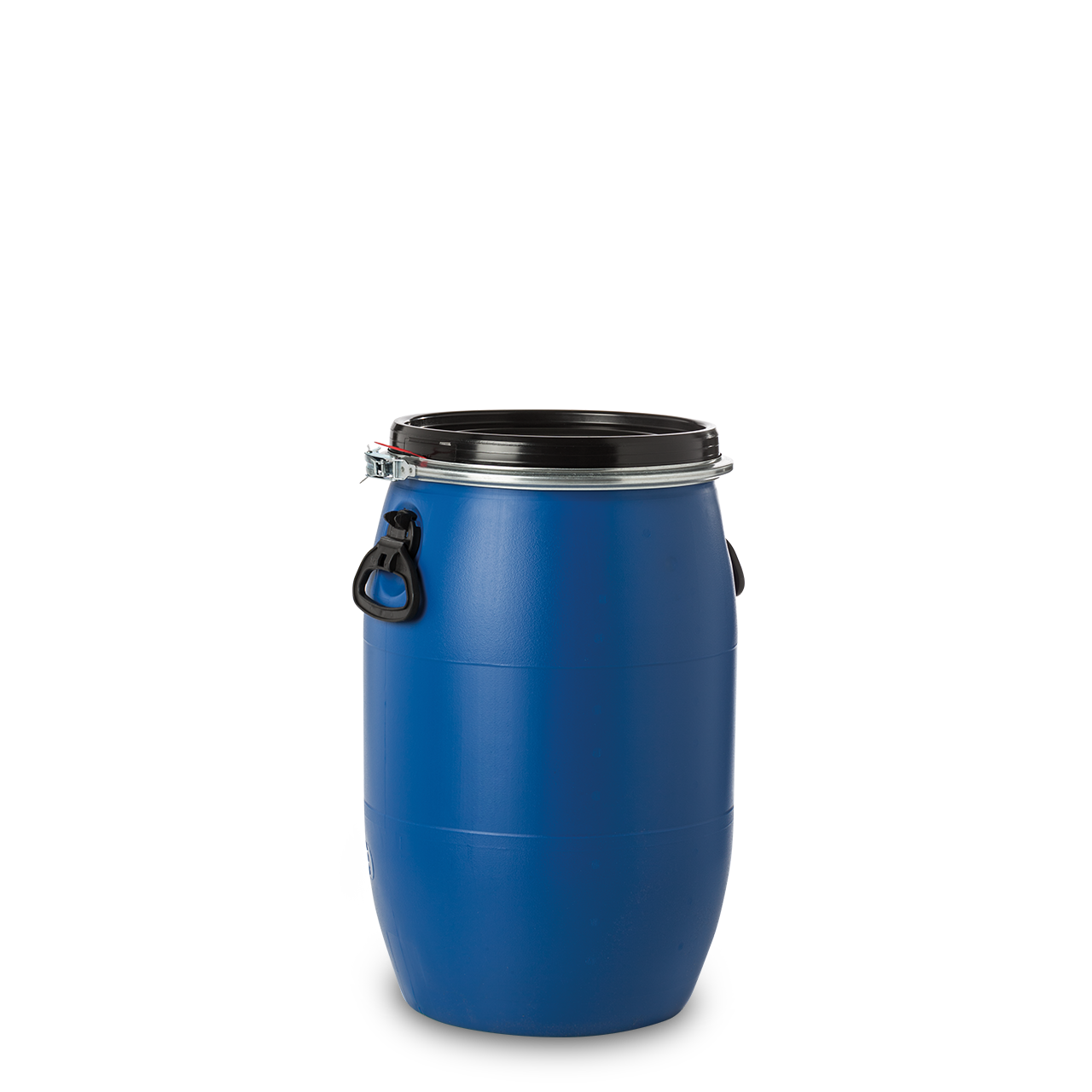
Some materials are difficult to place inside or remove from a narrow-neck container. Powders, granules, pastes, solids and high-viscosity formulations may require unrestricted access to the container interior. A Barrel With a Clamping-Ring Lid provides a removable-head design in which the lid is secured to the barrel rim with a separate clamping ring.
This configuration can simplify filling, emptying and inspection, but dependable containment requires the barrel body, lid, gasket and ring to be selected and applied as one complete system.
How Does a Clamping-Ring Closure Work?
Unlike a narrow-neck drum fitted only with a screw cap, a clamping-ring barrel has a lid that can be removed to expose most or all of the container opening. Once filling is complete, the lid is positioned on the rim and secured by tightening or locking the surrounding ring.
The main closure components generally include:
- A barrel body
- A matching removable lid
- A sealing gasket
- A metal or polymer clamping ring
- A lever, bolt or locking mechanism
- Additional security or tamper-evident features where specified
The gasket creates the sealing interface, while the ring maintains compression between the lid and barrel rim. A clamping ring should not be treated as a universal replacement part. Its diameter, profile and locking arrangement must correspond exactly with the barrel and lid.
Which Materials Benefit from a Removable-Head Barrel?
A large opening can make these barrels practical for materials that cannot be poured or pumped easily. Subject to product compatibility and container approval, possible applications include:
- Powders and granulated raw materials
- Pastes, gels and viscous compounds
- Solid components and bulk parts
- Absorbent materials
- Cleaning media
- Production intermediates
- Compatible resins and coatings
- Approved waste materials
- Dry ingredients
- Spill-response residues
For more general container formats, buyers can compare options within Plastic Buckets. The final choice should reflect the physical form of the contents rather than capacity alone.
A removable lid does not establish suitability for food, pharmaceutical, hazardous or regulated products. The appropriate documentation must confirm the intended application.
Why Is the Gasket a Critical Component?
The gasket fills small gaps between the lid and the barrel rim. Its performance can be affected by chemical exposure, temperature, compression, storage time and repeated opening.
An unsuitable gasket may swell, soften, shrink or become brittle. These changes can reduce sealing performance even when the clamping ring still appears secure. Compatibility should therefore be checked for the complete formulation, including solvents, additives and vapours.
Before closing the barrel, inspect the gasket for:
- Cuts or tears
- Permanent flattening
- Chemical attack
- Surface contamination
- Incorrect positioning
- Loss of flexibility
- An unsuitable size or profile
The sealing surfaces should be clean and free from product residue. Powder, fibres or dried formulation trapped under the gasket can create an incomplete seal.
How Should the Lid and Clamping Ring Be Applied?
Closure procedures should follow the manufacturer’s instructions and the organisation’s approved operating method. Improvised tools or excessive force can distort the ring, lid or barrel rim.
A controlled closing process normally includes checking that:
- The correct lid and gasket have been selected
- The rim is clean and undamaged
- The gasket is seated evenly
- The lid is level on the opening
- The ring surrounds the complete lid profile
- The locking mechanism is fully engaged
- Required security features are installed
- The closed barrel passes the relevant inspection
The ring should apply even pressure around the lid. If one section appears raised or misaligned, the closure should be reopened, inspected and reapplied. Hammering the ring into place can damage the barrel and should not replace the approved closure procedure.
How Does Barrel Material Affect Suitability?
Many industrial removable-head barrels are manufactured from polymers such as high-density polyethylene. Polymer barrels can offer useful impact resistance and lower weight than some metal alternatives, but resistance varies according to the chemical, concentration, temperature and contact period.
Buyers should evaluate:
- Barrel-body material
- Lid material
- Gasket composition
- Clamping-ring construction
- Product concentration
- Filling temperature
- Expected storage duration
- Exposure to sunlight or weather
- Permeation sensitivity
- Cleaning chemicals
- Required regulatory approvals
Compatibility information should come from current technical documentation. A barrel previously used successfully for one mixture may not be suitable when the concentration, temperature or formulation changes.
The wider Carboys, Canisters and Barrels range can support comparisons when a narrow-neck container, integrated outlet or different material would better suit the workflow.
Can Clamping-Ring Barrels Transport Dangerous Goods?
Only appropriately tested and marked packaging may be used for regulated dangerous goods. The presence of a clamping ring does not provide approval by itself. The complete packaging design—including the body, lid, gasket and closure—must match the relevant certification.
Users should confirm:
- The exact UN packaging code
- Whether approval covers solids, liquids or both
- Permitted packing group
- Maximum gross mass or liquid density
- Closure instructions
- Required gasket and ring
- Transport mode
- Manufacturing and inspection details
- Time limits or reuse conditions
- Compatibility with the intended substance
The UN marking must be interpreted against the shipment and applicable regulations. It should not be read as unlimited approval for all chemicals.
For lower-capacity regulated packaging, suitable Dangerous Goods Buckets may provide an alternative when their certification matches the material and transport requirements.
How Should a Barrel Be Filled?
The barrel should be positioned upright on a stable surface before filling. Operators must calculate the total filled weight and confirm that the floor, pallet and handling equipment can support it.
The filling procedure should control:
- Target weight or volume
- Available headspace
- Product temperature
- Foam or trapped air
- Splashing and dust generation
- Contamination of the rim
- Static-charge risk
- Operator exposure
- Closure timing
- Batch identification
Overfilling may contaminate the sealing surface or leave insufficient space for product expansion. Underfilling can also be undesirable when transport testing or process control depends on a defined filling condition.
Where manual filling is required, suitable tools should be dedicated to the product or cleaned according to an approved procedure.
What Is the Best Way to Handle a Filled Barrel?
Filled barrels can be heavy and difficult to control manually. Handling plans should be based on the total gross weight rather than the empty container weight.
Before movement, confirm that:
- The lid is correctly secured
- The clamping mechanism cannot open accidentally
- The barrel exterior is clean and dry
- Labels remain visible
- The base is not distorted
- The planned lifting method is approved
- The route is clear
- The receiving area is ready
- Secondary containment is available where required
Do not lift a heavy barrel by its clamping ring unless the manufacturer specifically approves that method. The ring is primarily a closure component and may not be designed as a lifting point.
A Hobbock may provide a manageable alternative for lower-volume applications requiring recessed grips or easier manual positioning. For routine smaller batches, a Round Bucket may also offer a more convenient format.
How Should Barrels Be Stored and Stacked?
Storage conditions influence both the contents and the container. Barrels should stand on level surfaces away from vehicle routes, sharp objects and incompatible materials. Outdoor storage should only be used where the barrel and contents are approved for the expected temperature, sunlight and weather exposure.
Stacking must follow the manufacturer’s instructions. A flat lid does not automatically mean that a filled barrel can support another container.
A storage assessment should cover:
- Maximum permitted stacking load
- Filled-barrel weight
- Storage temperature
- Duration of stacking
- Pallet quality
- Floor condition
- Segregation of incompatible products
- Spill containment
- Fire-safety requirements
- Inspection access
Where shelf or pallet space is limited, a Rectangular Bucket may offer a compact alternative for compatible lower-volume contents.
Can a Clamping-Ring Barrel Be Reused?
Reuse depends on the packaging design, previous contents, barrel condition and legal requirements. The body may appear undamaged while the gasket or ring has already reached the end of its service life.
Before reuse, determine whether:
- Reuse is permitted by the manufacturer
- Previous contents are known
- Residues can be removed safely
- Cross-contamination is acceptable
- The cleaning method is compatible
- The rim remains dimensionally sound
- The gasket should be replaced
- The ring closes correctly
- Transport approval remains valid
- A formal inspection is required
A barrel used for hazardous waste should not be reassigned to another purpose without a documented assessment. Empty barrels may still contain dangerous vapours or residues and must be handled accordingly.
Products available within Disposal can support spill collection and waste-management procedures where damaged packaging or residual materials require controlled handling.
What Should Buyers Confirm Before Ordering?
A focused purchasing review should include:
- Nominal and permitted filling capacity
- Barrel, lid and gasket materials
- Opening diameter
- Empty and maximum filled weight
- Type of clamping mechanism
- Handle or recessed-grip configuration
- Chemical-resistance information
- Filling-temperature limit
- Storage-temperature range
- Stacking restrictions
- Food-contact status where required
- UN approval and packaging code
- Suitability for solids or liquids
- Required closure instructions
- Replacement gasket and ring availability
- Cleaning and reuse limitations
- Pallet quantity
- Receiving and handling arrangements
Specifications should be assessed together. A large capacity is of limited value if the barrel cannot be moved, stored or closed correctly within the intended facility.
Improving Access Without Compromising Containment
A barrel with a clamping-ring lid combines broad interior access with a closure that can be removed and reapplied according to an approved procedure. This makes the format particularly useful for compatible powders, solids, granules, pastes and other materials that are difficult to handle through a narrow opening.
Reliable performance depends on much more than the ring itself. Careful material selection, an undamaged gasket, correct closure application, controlled filling and suitable handling equipment turn the barrel into a dependable packaging system. Reviewing these factors before purchase helps protect the contents while supporting more efficient filling, storage and material recovery.