

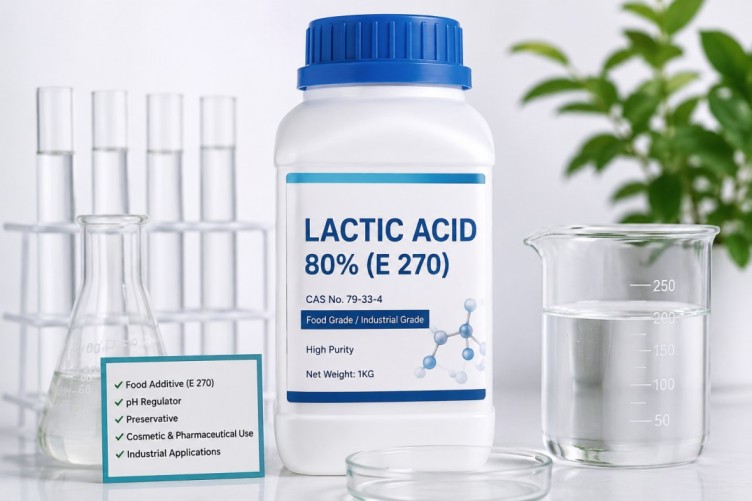
What Is Lactic Acid, 80 % (E 270)?
Products within the Lactic Acid, 80 % (E 270) category provide a concentrated aqueous form of lactic acid for suitable laboratory, industrial, formulation and food-processing applications.
Lactic acid is an organic hydroxy acid, while E 270 is the designation commonly associated with lactic acid in food applications. An 80% solution provides a strong liquid source of acidity while containing more water than higher-concentration grades.
This balance can make it practical for controlled dosing, dilution and liquid formulation processes.
What Is Lactic Acid 80% Commonly Used For?
Lactic Acid 80% may support applications where controlled acidity or lactate chemistry is required.
Depending on the product grade, possible uses include:
- pH adjustment
- Laboratory solution preparation
- Food and beverage formulation
- Buffer-related processes
- Chemical manufacturing
- Cleaning formulations
- Industrial acidification
- Preparation of lactate compounds
- Research and development
- Process optimisation
The correct quantity depends on the final formulation, required pH and total batch composition.
Why Choose Lactic Acid 80% for Liquid Formulations?
A ready-made liquid concentration can simplify processing compared with materials that must first be dissolved.
Potential advantages include:
- Faster incorporation into aqueous systems
- Easier controlled dispensing
- Reduced preparation steps
- Consistent starting concentration
- Flexible preparation of weaker solutions
- Convenient use in liquid dosing systems
An 80% solution may also require less dilution than stronger grades when the formulation already contains a significant amount of water.
How Should Lactic Acid 80% Be Measured?
Accurate measurement is important because small dosing differences can affect acidity and final product performance.
Products within Measuring and Mixing Cylinders can support routine measurement and preparation where their accuracy is suitable for the method.
Before measuring, users should confirm:
- Required acid quantity
- Starting concentration
- Final batch volume
- Equipment accuracy
- Temperature conditions
- Required tolerance
For highly controlled formulations, gravimetric measurement or calibrated dispensing equipment may provide greater precision.
How Can Lactic Acid 80% Be Added Without Over-Acidifying a Batch?
The safest process-control approach is gradual addition.
Adding too much acid at once may reduce the pH below the required range and create unnecessary corrective work.
A controlled sequence can include:
- Preparing the receiving liquid
- Starting mixing
- Adding most of the calculated acid slowly
- Allowing the batch to become uniform
- Measuring the result
- Making smaller final additions
As the target condition approaches, each acid addition should become smaller.
This method provides better control than adding the complete calculated quantity immediately and correcting afterwards.
Can Bottle Top Dispensers Improve Lactic Acid Dosing?
Suitable Bottle Top Dispensers can support repeatable liquid dosing when the dispenser materials are chemically compatible with the product.
They may help:
- Reduce manual pouring
- Improve dosing repeatability
- Limit spills
- Reduce excess material use
- Support repeated laboratory preparations
- Improve operator control
The dispenser should be checked regularly because seals, valves and other components can wear over time.
Calibration or performance verification may also be required where dosing accuracy is critical.
Why Is Mixing Important After Adding Lactic Acid?
Effective mixing helps ensure that the acid is distributed uniformly throughout the formulation.
Without sufficient agitation, one part of the vessel may temporarily have a lower pH than another. This can lead to inaccurate testing and inconsistent processing.
Suitable Magnetic Stirrers Without Heater can support controlled mixing of compatible laboratory-scale preparations where additional heating is unnecessary.
Important mixing factors include:
- Vessel size
- Sample volume
- Stir bar size
- Mixing speed
- Liquid viscosity
- Addition point
- Mixing duration
The batch should be allowed to become uniform before final testing.
Does Temperature Affect Lactic Acid 80% Handling?
Yes. Temperature can influence viscosity, liquid flow, measurement and mixing behaviour.
A colder concentrated solution may flow more slowly, while excessive heat can affect handling and process conditions.
Users should avoid making final measurements immediately after significant temperature changes.
Where temperature forms part of the approved procedure, both the acid and receiving batch should be monitored and recorded.
How Can a Representative Sample Be Collected?
Quality-control testing is only useful when the sample represents the complete batch.
Suitable Sample Beakers can support routine sample collection where their material and capacity suit the formulation.
Samples should normally be collected only after sufficient mixing.
A sample record may include:
- Batch number
- Sample location
- Collection time
- Temperature
- Operator
- Test required
Collecting a sample too early may produce a result that does not represent the final formulation.
What Is the Difference Between Lactic Acid 80% and Lactic Acid 90%?
The primary difference is concentration.
Lactic Acid 90% contains less water and provides more lactic acid per unit quantity. Lactic Acid 80% contains more water and may require less dilution for some formulations.
An 80% solution may be preferred when:
- The process already contains water
- Moderate concentration is sufficient
- Manual dosing is common
- Easier adjustment is useful
A 90% solution may be preferred when:
- Minimal water addition is required
- Storage volume is important
- Concentrated automated feeding is used
The two concentrations should not be substituted without recalculating the required quantity.
How Does Lactic Acid Compare with Citric Acid?
Both lactic acid and citric acid can provide acidity, but their chemical behaviour is different.
Citric acid has multiple acidic groups and can provide different buffering and metal-ion interactions. Lactic acid is a hydroxy acid with different formulation and sensory characteristics.
The choice may depend on:
- Desired pH
- Buffering behaviour
- Taste profile
- Processing method
- Required chemical functionality
- Product stability
Substitution should therefore be supported by formulation testing rather than acidity alone.
How Should Lactic Acid 80% Be Stored?
Lactic Acid 80% should remain in a compatible, tightly closed container under the conditions specified for the product.
Good storage practice includes:
- Keeping labels clearly visible
- Preventing contamination
- Protecting containers from excessive heat
- Maintaining spill containment
- Separating incompatible chemicals
- Checking closures regularly
- Following stock-rotation procedures
- Maintaining batch traceability
Secondary containers should never be left unidentified.
What Should Be Checked Before Using Lactic Acid 80%?
Before use, operators should verify:
- Product identity
- 80% concentration
- Product grade
- Batch number
- Packaging condition
- Certificate documentation
- Storage history
- Required application suitability
Unexpected changes in appearance, container condition or product performance should be investigated before the material is used.
Is Lactic Acid 80% Safe to Handle?
Lactic Acid 80% is a concentrated acidic material and should be handled with appropriate laboratory controls.
Depending on the procedure, these may include:
- Chemical-resistant gloves
- Eye protection
- Protective clothing
- Controlled dispensing
- Suitable ventilation
- Spill-response equipment
- Accessible eyewash facilities
The product-specific safety data sheet should always guide handling and emergency procedures.
Conclusion
Lactic Acid, 80 % (E 270) provides a practical liquid source of acidity for controlled formulation, laboratory preparation and suitable industrial processes.
Its effectiveness depends on accurate measurement, gradual dosing, complete mixing and representative sampling. Suitable measuring cylinders, bottle top dispensers, magnetic stirrers and sample beakers can support these steps within a well-controlled workflow.
By managing concentration, temperature, dosing, sampling and storage carefully, laboratories and manufacturers can achieve more consistent and reproducible results with Lactic Acid 80%.