

Introduction
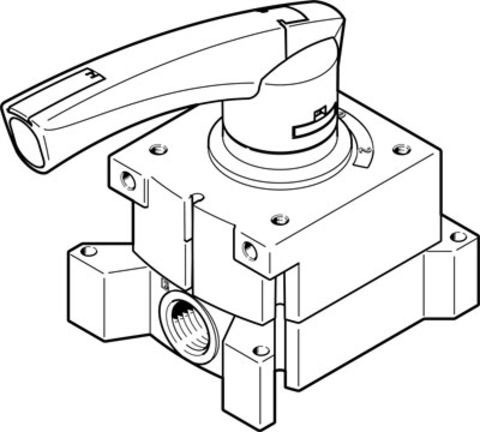
A Festo VHER Rod Lever Valve provides direct manual control over compressed-air flow in industrial pneumatic systems. By moving the lever between defined positions, an operator can start, stop, redirect, pressurise, or exhaust air without relying on electrical actuation.
The VHER range suits machinery that requires clear local control during setup, testing, adjustment, maintenance, or routine production. However, valve function, centre position, port size, flow capacity, lever material, and connection direction vary between individual models.
What Is a Festo VHER Rod Lever Valve?
The VHER is a manually operated directional-control valve. Its lever moves an internal rotary valve mechanism, changing the connections between the pressure, working, and exhaust ports.
Suitable Pneumatic Manual Control Valves allow operators to control pneumatic functions locally. Unlike a solenoid valve, the VHER does not require an electrical command to change its switching position.
Festo offers VHER versions with metal or polymer levers. Depending on the configuration, the valve can support front-panel mounting, through-hole mounting, or installation through dedicated mounting holes.
How Does Manual Lever Operation Control Airflow?
When the operator moves the rod lever, the internal rotary element changes the available airflow paths. The valve can direct supply air towards one working port while allowing air from another port to exhaust.
The lever remains in a selected position on detenting versions. This provides a clear mechanical state that operators can identify without maintaining continuous force on the handle.
Because the switching action is mechanical, the VHER is useful for local overrides, machine adjustments, maintenance controls, and processes where an operator must select a defined pneumatic condition.
What Does a 4/3-Way Valve Function Mean?
Many VHER models use a 4/3-way configuration. This design has four main pneumatic connections and three lever positions.
The two outer positions direct compressed air towards opposite sides of a double-acting actuator. The middle position defines how the working ports behave when the lever returns or moves to the centre.
Festo also documents that selected VHER valves can operate as 3/3-way valves when the appropriate port is closed. This arrangement may support single-acting cylinder control.
How Do the Centre Positions Affect Cylinder Movement?
The centre function is one of the most important selection factors because it determines what happens when the lever is in its middle position.
Closed Centre
In a closed-centre version, the principal airflow paths are blocked. The valve can limit airflow to and from the actuator, helping pause movement within the stroke.
However, compressed air is elastic, and internal leakage or external forces may still allow gradual movement. Therefore, a closed centre should not be treated as a mechanical locking device.
Exhausted Centre
In an exhausted-centre version, the working ports connect to exhaust. Pressure is released from the actuator chambers, which can allow the piston or mechanism to move manually with only frictional resistance.
Festo states that VHER valves can stop double-acting cylinders within their stroke, while the resulting behaviour depends on the selected centre function and the forces acting on the actuator.
Which Actuators Can the VHER Valve Control?
A VHER valve can manually control pneumatic cylinders used in clamping, positioning, lifting, transferring, opening, and closing mechanisms.
Compatible Pneumatic Piston Rod Cylinders convert the controlled airflow into linear motion. The valve must provide sufficient flow for the cylinder bore, stroke, speed, and operating pressure.
Single-acting cylinders generally require a suitable 3/3-way arrangement, while double-acting cylinders commonly use the full 4/3-way function.
Why Are Stable Pressure and Clean Air Important?
The valve can only provide predictable control when the compressed-air supply remains clean and stable. Moisture, rust, oil residue, and particles may affect seals, internal passages, and downstream actuators.
Suitable Filter Regulators combine particle filtration, condensate separation, and pressure control before air reaches the valve.
Where a separate adjustment stage is required, Pneumatic Pressure Regulators help establish the required operating pressure. The regulator must also provide sufficient flow during actuator movement.
How Do Port Size and Flow Capacity Affect Selection?
The VHER family includes model-dependent pneumatic connections such as M5, G1/8, G1/4, and G1/2. Documented flow capacities vary considerably across the range, so buyers must check the exact product code rather than relying on the VHER name alone.
A valve with insufficient flow can slow cylinder movement and create pressure loss. Meanwhile, an unnecessarily large valve may require more space and increase installation costs.
Important selection factors include:
- Valve function and pneumatic symbol
- Closed or exhausted centre position
- Required nominal flow
- Operating-pressure range
- Port size and thread standard
- Side or underneath connections
- Lever material and orientation
- Mounting method
- Position-sensing requirements
- Ambient and media temperature
How Should the Valve Be Connected?
Correctly selected Pneumatic Fittings provide secure connections between the VHER ports, tubing, air preparation, and actuator.
The chosen Air Hose must match the fitting diameter, working pressure, temperature range, flexibility, and environment.
Tubing should be cut squarely, connected securely, and routed without sharp bends. Installers should also avoid allowing thread sealant, swarf, or dirt to enter the valve passages.
Can the Lever Position Be Monitored?
Selected VHER configurations support sensors for detecting the lever’s switching position. This feature allows a controller to confirm whether the operator selected the expected pneumatic state.
Compatible Pneumatic Cylinder & Actuator Sensors can also monitor actuator movement elsewhere in the system.
Position feedback improves sequence verification and diagnostics, but it does not replace safe isolation or mechanical load support.
Where Is a Festo VHER Rod Lever Valve Used?
The valve suits applications that require dependable local pneumatic control, including:
- Machine setup and commissioning
- Manual cylinder positioning
- Clamping and fixture adjustment
- Conveyor stops and diverters
- Packaging equipment
- Maintenance and testing stations
- Pneumatic lifting or lowering controls
- Production changeover mechanisms
It is particularly useful when operators need immediate tactile control and clear lever positions.
How Should the VHER Valve Be Maintained?
Inspect the lever, valve body, mounting hardware, fittings, tubing, and exhaust ports regularly. Look for leakage, stiffness, contamination, corrosion, or unexpected actuator movement.
Before maintenance, isolate the compressed-air supply and release stored pressure. Secure suspended loads independently because changing the lever position or exhausting the circuit may allow movement.
Use compatible replacement parts and follow the technical information for the exact VHER model.
Why Choose the Correct Festo VHER Rod Lever Valve?
The correct Festo VHER Rod Lever Valve provides simple, direct, and dependable manual airflow control. Its selectable centre functions can support cylinder positioning, controlled exhaust, local adjustment, and machine commissioning.
Reliable operation depends on matching the valve function, port size, flow, pressure, lever design, mounting method, and actuator requirements to the application. Proper selection creates a pneumatic control point that is practical, responsive, and easy for operators to understand.