

Introduction
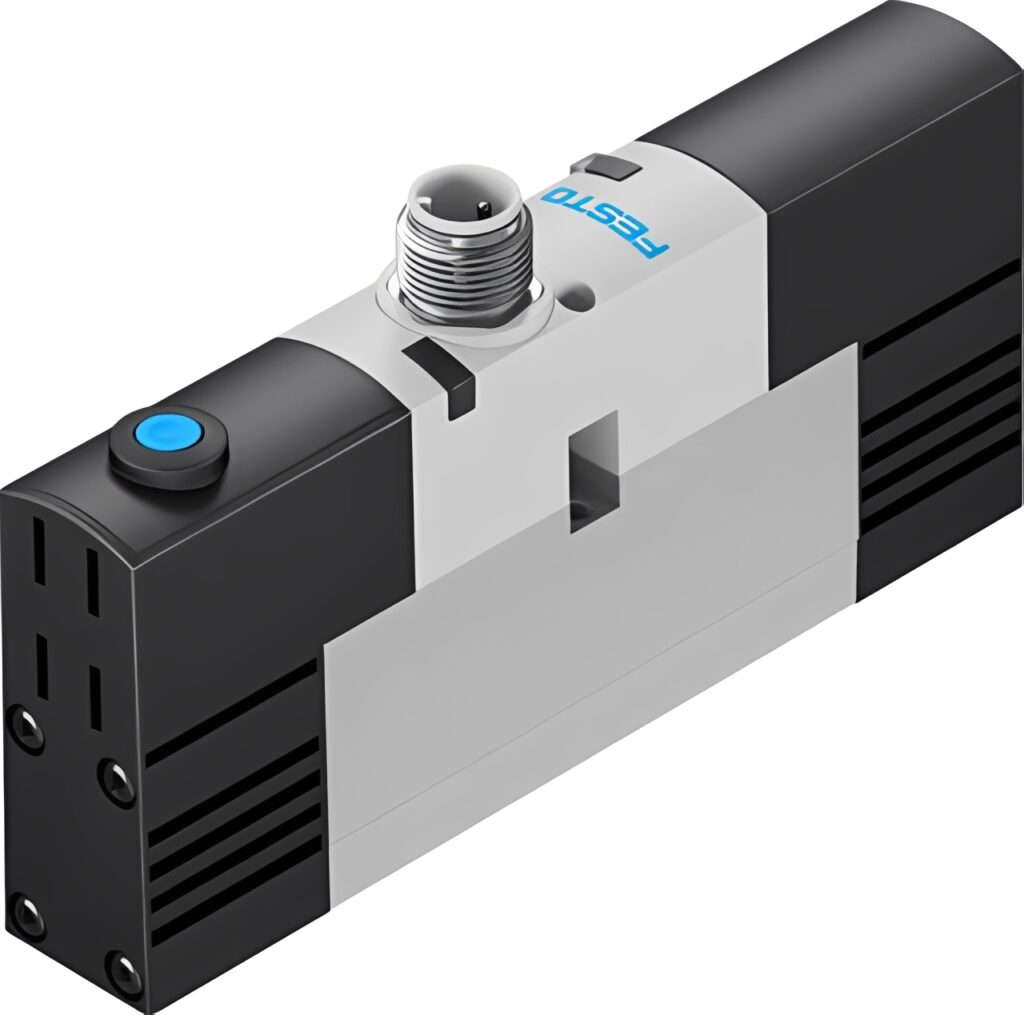
In automated machinery, a Festo 5/2 Monostable Solenoid Valve provides predictable control for double-acting cylinders and other two-direction pneumatic devices. One electrical signal shifts the valve, while a spring or pneumatic return restores its normal position when power is removed.
This behaviour suits clamping, positioning, packaging, testing, and product-handling systems that need a clearly defined resting state.
What Does 5/2 Monostable Mean?
The 5/2 designation indicates five ports and two switching positions. A typical arrangement includes one pressure-supply port, two working ports connected to the actuator, and two exhaust ports.
Monostable means the valve has one stable default position. Energising the single solenoid moves the internal spool or poppet into the second position. Removing the signal allows the return mechanism to shift it back automatically.
Festo offers 5/2 single-solenoid options within the VUVG and VUVS families. The VUVG range focuses on compact installation, while VUVS models provide robust construction, several connection sizes, and higher flow options for broader industrial duties.
How Does the Valve Move a Cylinder?
A double-acting cylinder has two chambers. In the valve’s resting state, compressed air reaches one chamber while the opposite chamber connects to exhaust.
When the coil is energised, the airflow paths reverse. Air enters the second chamber, displaced air leaves the first chamber, and the cylinder moves in the opposite direction.
Once the signal ends, the valve returns to its default state. Therefore, designers can define how the actuator should respond after a normal command or electrical interruption.
Why Is the Default Position Important?
The normal position affects machine behaviour during startup, shutdown, signal loss, and fault recovery. A clamp may need to release when power disappears, while another mechanism may require separate load-holding measures.
Engineers must consider trapped pressure, gravity, external loads, stored energy, and the complete machine risk assessment. Reliable Monitoring Relays can supervise selected electrical conditions before normal valve operation continues.
Where Are 5/2 Monostable Valves Used?
Assembly and Clamping Equipment
Assembly systems use these valves to operate clamps, locating pins, ejectors, stops, and transfer slides. The single-solenoid design simplifies the command circuit while the return mechanism establishes the normal position.
Packaging and Sorting Machinery
Packaging lines depend on repeated pneumatic movements for sealing, diverting, guiding, gripping, and product transfer. Correct valve sizing supports consistent cycle timing.
Protected Cable Glands can secure valve wiring where conductors enter control cabinets or machine enclosures.
Guarded Machine Cells
Automated equipment often operates behind doors or movable guards. Suitable Door Interlock Switches can confirm guard position before hazardous movement is permitted.
The valve itself is not a complete safety device. Guarding, isolation, exhaust control, and stored-energy management must work together.
Which Specifications Should Be Checked?
Flow Capacity
The valve must pass enough air for the actuator bore, stroke, load, tubing length, and target speed. An undersized valve can cause slow travel, hesitation, or incomplete movement.
Festo lists flow rates of 180 to 660 litres per minute for the compact VUVG range and 550 to 1,600 litres per minute for VUVS models. Exact performance depends on the selected valve configuration.
Port Size and Pressure
Connection size affects fitting compatibility, but it does not define flow performance by itself. Review operating pressure, pilot requirements, nominal flow, exhaust conditions, and approved mounting orientation together.
Coil Voltage and Electrical Interface
The coil voltage must match the controller output or power supply. Festo lists 24 V DC as a standard option across the highlighted VUVG and VUVS ranges, although connector arrangements vary by model.
Properly rated Solid State Relays can provide electronic switching where the control architecture and coil requirements are compatible.
Suitable Power Relays can provide electromechanical isolation when their coil, contact, and endurance ratings match the circuit.
How Should Electrical Safety Be Integrated?
Removing coil power changes a monostable valve to its resting position, but that response may still create movement. Designers must assess whether the resulting actuator action is safe.
Accessible Emergency Stop Push Buttons can support an engineered stop function while the pneumatic design manages pressure and stored energy.
Emergency stopping should not rely only on removing coil power. Safe exhaust, mechanical restraint, load holding, or controlled stopping may also be necessary.
How Should the Valve Be Installed?
Before installation, isolate electrical power and fully depressurise the pneumatic circuit. Confirm the valve symbol, port numbers, flow direction, coil voltage, mounting method, and normal position.
Good installation practices include:
- Keep open ports free from dust and debris
- Use compatible fittings and sealing methods
- Support tubing to prevent side loading
- Keep exhaust passages unrestricted
- Protect wiring from heat and abrasion
- Leave access to the manual override
- Check all joints for leakage
Organised Cable Assemblies can simplify repeatable wiring where the connector, pinout, voltage, and protection rating suit the installation.
How Should Commissioning Be Performed?
Begin with controlled pressure and reduced machine speed. Energise and de-energise the valve while checking cylinder direction, return behaviour, sensor feedback, and mechanical clearance.
Confirm that the actuator returns to the intended position after the signal is removed. Test power-loss behaviour only under safe and supervised conditions.
What Causes Unreliable Switching?
Contamination, low pilot pressure, restricted exhaust flow, incorrect voltage, loose wiring, damaged connectors, or worn seals can affect performance.
If the coil energises but the actuator does not move correctly, inspect the whole circuit. The cause may be pressure loss, undersized tubing, blocked exhaust components, mechanical resistance, or the actuator itself.
Why Choose a Festo 5/2 Monostable Solenoid Valve?
A Festo 5/2 Monostable Solenoid Valve combines simple electrical control with automatic return to a defined resting state. It supports dependable two-direction movement across assembly, packaging, handling, and testing systems.
By matching flow, pressure, port size, coil voltage, default position, installation method, and safety requirements, engineers can create a responsive pneumatic circuit that remains practical to diagnose and maintain.